Destinations
2026
- South Africa: Cape & the Garden Route
- Extremadura
- Crete
- South of Salamanca
- Picos de Europa
- French Pyrenees (June)
- Bulgaria's Western Rhodopes
- Falsterbo
- Danube Delta
- Madeira
2027


Bulgaria, the Western Rhodopes
25 June - 2 July 2026
Rare lilies, mountain butterflies and more
Few countries can rival Bulgaria’s scenic splendour and diverse nature. The country’s most valuable natural features are protected in three national parks, twelve nature parks and numerous wildlife and nature refuges.
The higher plants number about 3,500 species, including more than 400 Bulgarian and Balkan endemics and nearly 70 species of orchids. Bulgaria boasts the richest dragonfly and butterfly fauna in Europe.
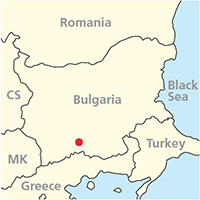
This holiday concentrates on the mountains, meadows and gorges of the Western Rhodopes. The Rhodope Mountains are in southern Bulgaria, close to the border with Greece.
The mountains’ pine-clad slopes are occasionally cut by rivers winding through deep gorges, one of which is the magnificent Trigrad Gorge. Around the limestone cliffs of the gorge we can enjoy birds like peregrine, alpine swift, crag martin, red-rumped swallow and dipper. Elsewhere in the forests, crags and mountain meadows of the Western Rhodopes we hope to find black woodpecker, alpine and pallid swifts, nutcracker, sombre tit, red-backed shrike and rock bunting.
The cultural heritage and traditions of Bulgaria include magnificent architecture from the 18th and 19th centuries in many towns and villages. Ancient icons, breath-taking murals and superb woodcarvings preserved in monasteries and churches, form just a part of the religious, historic and cultural wealth.
Other traditions include the tasty Bulgarian cuisine, salads especially, good local wines and, in our experience, a warm welcome in the mountain village of Yagodina. Here we are based at the family-run Hotel Yagodina, well located for walks around the village.

Rhodope lily (Lilium rhodopaeum), June 2024.
Flowers
Low intensity agriculture means that the Western Rhodopes have retained vast swathes of beautiful grasslands, with a dazzling array of wild flowers, a mixture of familiar species and local specialities.
In the gorges especially, there are several endemic species, one of the best known being Haberlea rhodopensis, which is related to African violets, though at the very end of its flowering season for us. Others endemics include Valeriana montana, Rhodope sandwort Arenaria rhodoaea, a bellflower Campanula orphanidea and the saxifrage Saxifraga stribrnyi. There are four geum species, two foxgloves, three wintergreens, an unusual bugle Ajuga lazmanii, St Bernard’s lily and many orchids – just a few names from so many in a rich and varied area for a botanist. The group in 2024 found the legendary ghost orchid, though we dare not tempt fate by picturing it here as it is famously elusive.
Perhaps the star species is the Rhodope lily, found only here and in nearby Greece. It’s in flower-rich high mountain meadows, along with corncrakes and swarms of marsh fritillaries and other butterflies.


A small part of the extraordinary Morina persica; yellow birdsnest.
Butterflies
The bewildering variety – 72 species on one previous visit – includes many local or unusual species: Balkan zephyr blue, Balkan copper, powdered brimstone and poplar admiral. These mingle with butterflies found more widely in mainland Europe, such as spotted, Queen-of-Spain and Glanville fritillaries, Apollo, chestnut heath, Idas blue and more.
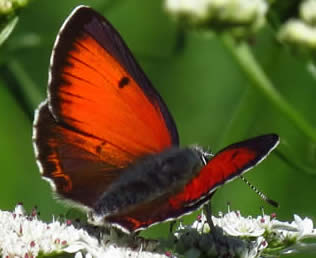
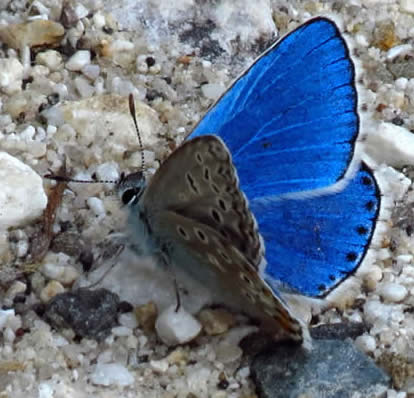
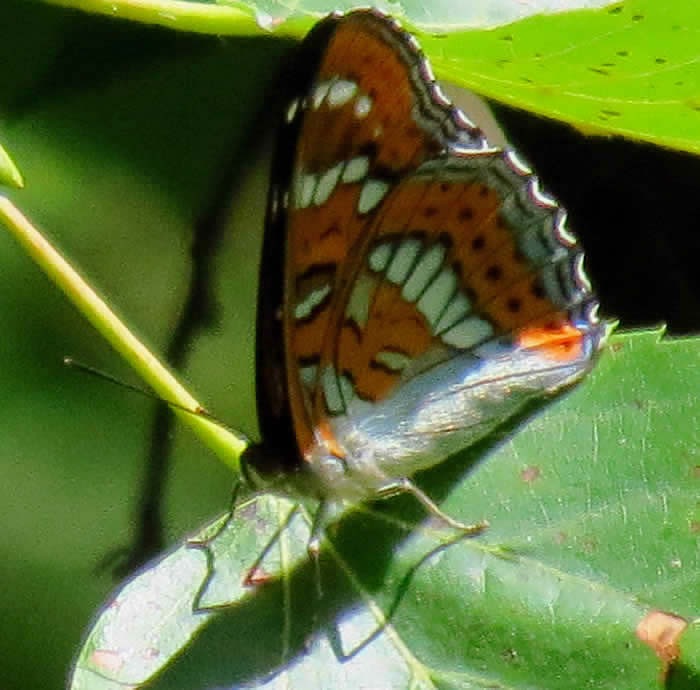
Balkan copper, Balkan zephyr blue, poplar admiral (Chris Gibson).
Other wildlife
Red squirrel, pine marten and wild cat are found in the mountains, plus souslik in the lowlands. Agile frog and fire salamander occur. Among a big range of dragonflies, moths and other invertebrates, one of the most spectacular is the pennant-winged ant-lion.
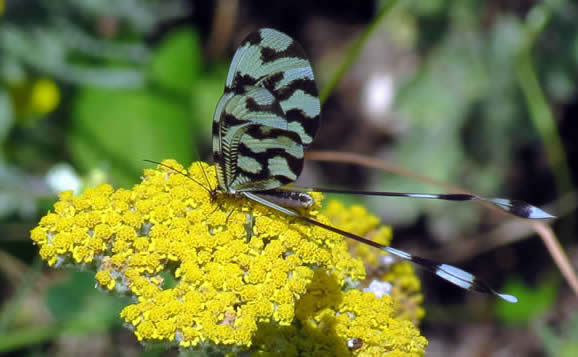

Pennant-winged ant-lion Nemoptera sinuata (Chris Gibson); Ripart's anomalous blue.

Honeyguide group in Yagodina, 2024.
Hotel
In Yagodina, we stay at the family-run Hotel Yagodina.
Holiday details
Price: £1,800 per person in twin room for a full week (Thursday to Thursday).
Single room supplement: £140
En suite facilities.
Flights: Scheduled Wizz Air flights, London Luton to Plovdiv
Thursday 25 June: W9 5391 depart London Luton 06:10 arrive Plovdiv 11:35
Thursday 2 July: W9 5392 depart Plovdiv 12:15 arrive Stansted 13:50
Deposit: £400
Maximum number: 14
Leaders
Vladimir (Vlado) Trifonov has a Master's degree in Ecology, with a thesis in Botany and Environmental Conservation. Over the last 20 years, Vlado has been involved in monitoring vascular plants in the Eastern Rhodopes region, mapping habitats of European importance in NATURA 2000 sites, research, conservation and monitoring of the griffon vulture and imperial eagle. As a dedicated conservationist he has participated in the process of designation of new protected areas, as well as in numerous projects related to the study, conservation and monitoring of biodiversity. He is co-author of the action plan for the endemic rhodope lily (Lilium rhodopaeum) and leader of our natural history and botany tours in Bulgaria.
Since 2003 he has worked at the Ministry of Environment and Water - Regional Inspectorate - Haskovo, where he is responsible for the conservation of protected plant and animal species, protected areas, the national biodiversity monitoring system, etc.
Tim Strudwick had almost three decades of service to wildlife conservation in the Norfolk Broads, perhaps best known as the site manager at the RSPB's Strumpshaw Fen nature reserve. He retired in 2025: see local news story here. He is the Norfolk recorder for bumblebees, solitary bees & wasps. Tim does freelance work in biodiversity management and entomology; right now he is working through a few thousand Hymenoptera specimens for the Breckland Farmers Wildlife Network. Tim was co-leader, with Vlado, in Bulgaria for our holiday in 2016.
Conservation project
The Rhodope lily Lilium rhodopaeum is a very scarce flower of the Western Rhodopes. It’s found on just a handful of sites in Bulgaria and just over the border in Greece, about half of which have no official protection. Our local leader, Vlado, is the Bulgarian authority on this spectacular endemic, and with our help leads on its monitoring and conservation.
Ove the years, donations have been split between BSPB and Vlado Trifonov. For BSPB, this has funded meetings with local stakeholders as BSPB continues to lobby to get Tzigansko Gradishte designated for nature conservation. For Vlado it has for several years funded monitoring and mowing at the location visited by Honeyguiders.
More on the conservation of Lilium rhodopaeum here.

Top: nine-spotted moth and rose chafer. Bottom: Geum rhodopaeum.
For prices, see Holiday Details at the bottom of the page.
 |
FCO travel advice for Bulgaria here. |
This holiday is run in partnership with Neophron Tours.
RHS Lily Group
We are expecting that some group members in 2026 will be from the Royal Horticultural Society Lily Group.
The RHS Lily Group has been following the story of Lilium rhodopaeum (more here), hence the plan to visit.

Apollo, June 2024, on dwarf elder.

Red-backed shrike on a rooftop in Yagodina (Everard Daniel).

Martagon lily.
Reports
Bugs and Beasties of the Western Rhodopes. 6MB PDF. A photoguide to some lesser-known species, by Chris Gibson and Judith Poyser.
Holiday report, June-July 2024.
Holiday report, June 2014. More holiday reports here.
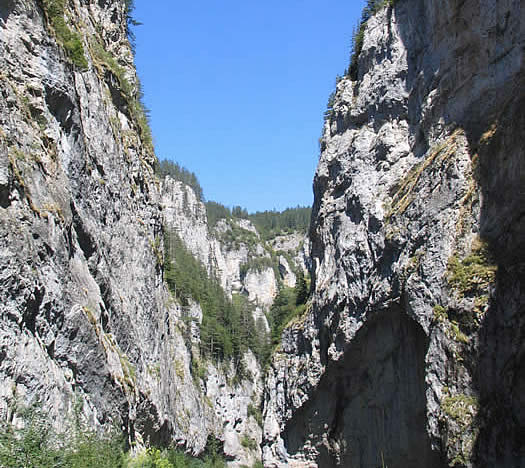
Trigrad gorge (Dimiter Georgiev)

Scarce copper
Honeyguide web pages
Rhodope lily Lilium rhodopaeum
Poda nature reserve and other news from Bulgaria, January 2011 - click here
For many years, there were fine views of wallcreepers at a roadside stop in Trigrad Gorge. After an absence, they were there again for the group in 2024.
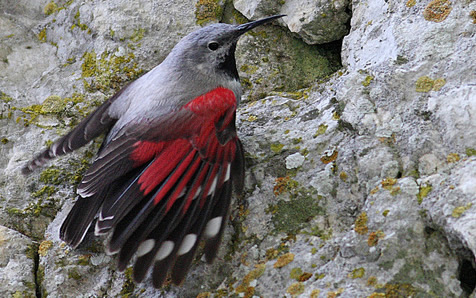
Wallcreeper (Svetoslav Spasov)

Spurge hawkmoth caterpillars
Bulgaria photos
Tim Strudwick's photos, June 2016.
Gallery: pictures from the recce visit to Bulgaria in September 2008.
Pictures from June 2010 by Honeyguider Brennan Aunger here. Click on 'photo album'.

Brown bear footprints, 2024
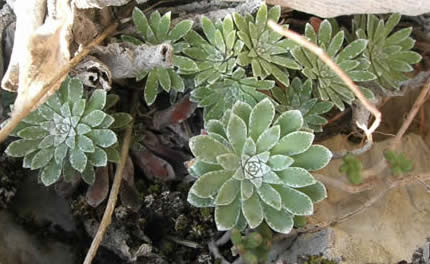
Rosettes of Saxifraga stribrnyi, endemic to the Rhodope Mountains.
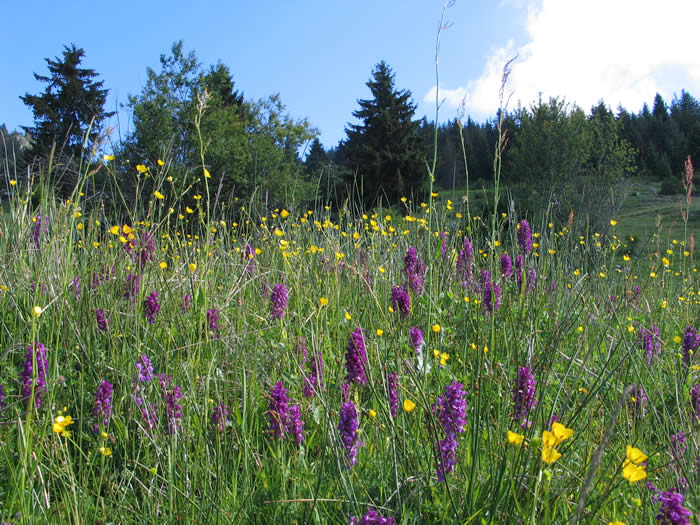
A meadow in June in the Trigrad area of the Western Rhodopes (Dimiter Georgiev)

Foxglove Digitalis lanata.
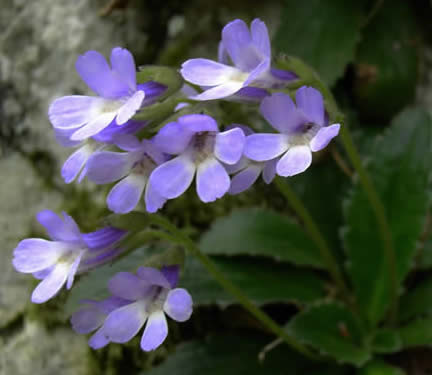
Haberlea rhodopensis (Mihaela Yordanova)
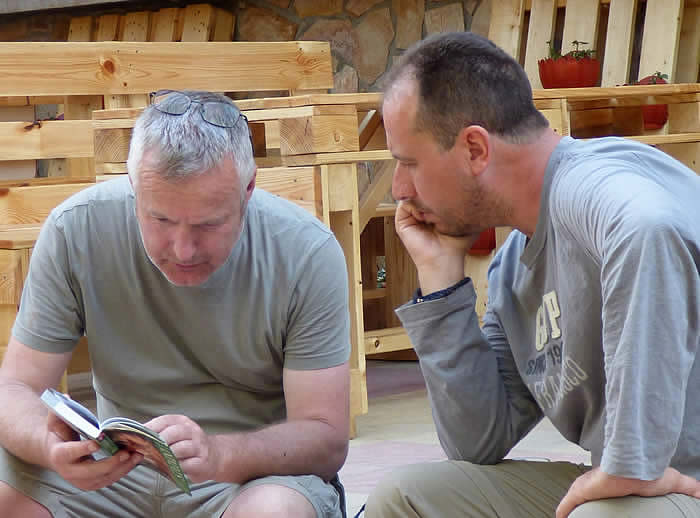
Valdo, right, discusses an ID with Tim Strudwick.
SUPPORTING

Lilium rhodopeaum
For reference
Crossbill Guides are reliably good and the Rhodope Mountains guide (published April 2023) will be good background reading. It covers the Eastern Rhodopes as well as the Western Rhodopes.
Before return flights from Plovdiv were possible, we flew to/from Sofia. Before the return flight we used to stay at Bashtina Kashta (Father’s House) Hotel in the conservation village of Koprivshtitsa. More about Koprivshtitsa on Wikipedia here.

