Destinations
2026
- South Africa: Cape & the Garden Route
- Extremadura
- Crete
- South of Salamanca
- Picos de Europa
- French Pyrenees (June)
- Bulgaria's Western Rhodopes
- Falsterbo
- Danube Delta
- Madeira
2027


Carbon credits
We’re serious about our responsibility to tackle global climate change. That’s why Honeyguide is offsetting its CO2 emissions by buying ‘carbon credits’ for every holiday flight.
Air travel makes up only a small fraction of the UK’s greenhouse gas emissions at present, but that fraction is growing. As an environmentally-minded company, we aim to keep our carbon emissions as low as possible, but we all realise it’s hard to cut our pollution entirely.
Realistically, most of our travellers will fly. We make an annual calculation of the emissions from the flights we use, then buy our carbon offsets, described below.
Carbon offsets
In the early years, Honeyguide supported projects that remove carbon dioxide from the air by replacing polluting technologies with clean ones. These were then the best projects available: the thinking (then) was that 'carbon credits' were bought in projects that prevent the same amount of carbon dioxide from entering the atmosphere.
We now try to support projects that restore nature. Restoring nature has a great ability to sequester carbon, while providing benefits to wildlife and local communities.
Therefore our aim - for a long time, quite a challenge - is to find carbon offsets projects that achieve the ‘gold standard’ in terms of measuring carbon savings (see 'gold standard' below) while also contributing to nature conservation and local livelihoods – the 'win-win-win' of the best projects. Wildlife gains are a key priority for us.
Gola Rainforest in Sierra Leone
Honeyguide's purchases of carbon credits in recent years have supported Gola Rainforest National Park in Sierra Leone. There is more information about Honeyguide's contributions plus various links below. The purchases were for fewer tonnes in recent years, reflecting a smaller programme of holidays since the break during the Covid pandemic.
There is a very good summary of how carbon credits work to support Gola Forest's wildlife and local communities in this BirdLife story from March 2023.
July 2025: Sierra Leone’s Gola Rainforest has been named a new UNESCO World Heritage site for its global importance to wildlife. More information on the RSPB's website here.
For an eighth time, we have bought carbon credits that protect tropical forest in Gola Rainforest National Park in Sierra Leone. The July 2025 purchase was for 43 tonnes of carbon credits through Stand for Trees. The cost was £19/tonne x 43 tonnes = £817. The certificate looks the same as in recent years - that certificate is here.
2024: for a seventh time, we have bought carbon credits that protect tropical forest in Gola Rainforest National Park in Sierra Leone. The September 2024 purchase was for 57.5 tonnes of carbon credits through Stand for Trees (certificate here). The cost was £19/tonne x 57.5 tonnes = £1092.50.
2023: for a sixth time, we have bought carbon credits that protect tropical forest in Gola Rainforest National Park in Sierra Leone. The September 2023 purchase was for 52 tonnes of carbon credits through Stand for Trees (certificate here). The cost was £19/tonne x 52 tonnes = £988.
2022: for a fifth time, we have bought carbon credits that protect tropical forest in Gola Rainforest National Park in Sierra Leone. The September 2022 purchase was for 56 tonnes of carbon credits through Stand for Trees (certificate here).
The fourth purchase, in September 2019, was for 131 tonnes of carbon credits (certificate here).
The third occasion, in September 2018, was a purchase of 105 tonnes of carbon credits (certificate here). Work with camera traps in Gola Forest has given interesting results: more on that and wildlife-friendly chocolate on the RSPB's website here.
in September 2017 we bought 104 tonnes of carbon credits - certificate here - for the same Gola Forest project (thank you to Honeyguide here). This was our second purchase: the first, in July 2016, covered three previous years with 250 tonnes of carbon credits (certificate here).
The project is jointly managed by the RSPB, the Conservation Society of Sierra Leone and the Government of Sierra Leone. There's a video about the project on YouTube here.
The wildlife benefits of protecting this rain forest, an Important Bird Area, are immense. White-necked picathartes is one of the flagship bird species, but there is so much more. Read about the wildlife of Gola Rainforest here.
Though announced in the RSPB's magazine in autumn 2014, the formal establishment of this REDD project (right) took nearly two more years to be up and running. Unfortunately, relatively small-scale purchases of carbon credits to support Gola Forest are no longer possible: Stand for Trees stopped selling carbon credits in 2025.
Martin Harper, formerly the RSPB’s Global Conservation Director (now at at BirdLife International), wrote several blogs on Gola Forest, though these are no longer online. I lifted this quote from one of these:
Marin Harper says: "While the top priority must be to reduce greenhouse gas emissions in absolute terms, our view is that carbon offsetting can be a valuable source of funding to support conservation efforts. So, we support offsetting projects when clear and exemplary biodiversity, carbon and social standards are adopted." Honeyguide agrees: this chimes with the first paragraph above.
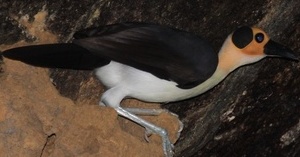
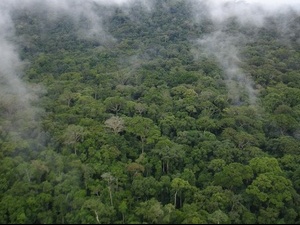
White-necked picathartes (Neil Lambert, RSPB) and Gola Rainforest c/o www.golarainforest.org
Gold standard
There are various schemes on the market to buy carbon offsets, but they vary in quality. We seek carbon offsets that conform to the measurable standards agreed by the industry (Voluntary Carbon Standard or Gold Standard). Other schemes may have carbon benefits but are not clearly measured or measurable.
A particular challenge is that money paid for by some voluntarily 'offsetting' makes no net reduction in emissions: what you’ve paid for, the Government no longer has to.
Carbon offset projects supported through Carbon Clear, 2009-2013
For six years, Honeyguide bought Carbon Credits through Carbon Clear www.carbon-clear.com and we're grateful for their help in this period..
For 2013, we bought Carbon Credits in two places in East Africa. Some of these are again at Kibale National Park reforestation in western Uganda - details under 2012.
One Honeyguider, Margaret Dixey, visited Kibale when her daughter was working on a VSO programme in Uganda. Margaret says, "I am thrilled Honeyguide has chosen to support Kibale. I was very impressed with the work there, particularly the programme for chimpanzees and was very excited to see a family of chimps during a guided walk there."
The other project we are supporting in 2013 is the Kasigau Corridor REDD project in Kenya, west of Mombasa and close to the border with Tanzania. This is preventing deforestation in an area that forms a valuable wildlife corridor linking Tsavo East and Tsavo West National Parks. This REDD project (see right hand column) is the first to gain Voluntary Carbon Standard validation. More information here.
Both projects appeal to us as they combine measurable, verifiable carbon credits with clear biodiversity gains, plus benefits for the local human community.
For 2012, we bought 71 tonnes of Carbon Credits in Kibale National Park reforestation in western Uganda, at a cost of £535. This reforestation project, run in cooperation with the Uganda Wildlife Authority, aims to establish new forest cover over 6,213 ha of degraded land inside the park through the planting of fast growing indigenous tree species. More information here (PDF) There is a brief write-up on Kibale National Park and the reafforestation efforts on Wikipedia here, and a lot more on the long-term sustainable management of the area here: this link takes you to a PDF of the Equator Initiative of the United Nations Development Programme.
This project appeals to us as, for the first time, it combines measurable, verifiable carbon credits with clear biodiversity gains. This '3-legged stool' is our own measure for a good project, in addition to the principles applied by Carbon Clear (see below).
In 2011, Honeyguide bought 30 tonnes of Carbon Credits in a small hydropower project in Turkey. This generates clean hydroelectricity from a small 5MW plant, reducing carbon emissions by displacing fossil fuel use. The project supports the local economy by providing jobs and a sustainable fishery. More information here.
This amount is lower than previous years as we used to predict and buy in advance. For the first few years this was roughly correct, but we over-provided in 2010 because of holidays cancelled due to volcanic ash and an air traffic control strike. This has been taken into account in the latest calculation and we now buy carbon credits retrospectively.
Our project in 2009 and 2010 was to offset our emissions by investing in a project to replace firewood cooking stoves with low smoke LPG stoves in Darfur, Sudan. These reduce carbon emissions, benefit wildlife by reducing wood cutting and provide huge health benefits for families.
 |
For more information on this project click here. In April 2011, Carbon Clear's Darfur Stoves Project made the finals of the Green IT's Carbon Offsetting Scheme of the Year. |
Carbon Clear applies the following principles to all its projects: "They must be efficient. Funds should not be diverted to unnecessary bureaucratic overheads, waste or middlemen. They must have additional, long-term benefits to the communities that undertake them. These range from employment opportunities to the protection of endangered species of plants and animals. They should follow the spirit of the Kyoto agreement. Projects must make pollution reductions over and above their normal level, and it is only this additional benefit to the environment that Carbon Clear supports."
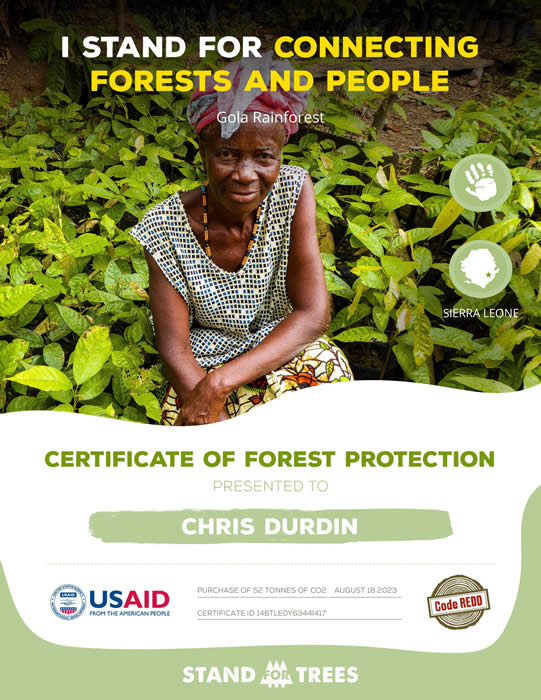
Above is our 'Certificate of Forest Protection' for carbon credits bought in August 2023, contributing to the protection of Gola Forest in Sierra Leone. We received the same style of certificate in September 2024 - see 2024 details.
This may be easier to read in this PDF certificate here. More in this page's main text.
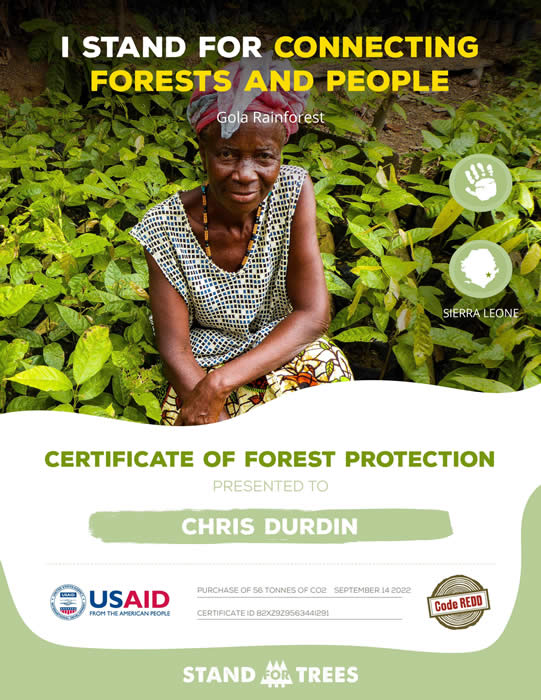
Similarly, here is our 'Certificate of Forest Protection' for carbon credits bought in September 2022, contributing to the protection of Gola Forest in Sierra Leone.
You can also see this as a PDF certificate here and read more about this in this page's main text.
Honeyguide was one the first companies to introduce carbon offsets. See news release, September 2006, here.
Also from the early years: carbon credits certificate for 2012/13 here. Also 2011 here, 2010 here and 2009 here. Others are in the commentary in the main column.
Ideally, we'd buy carbon offsets in a country that Honeyguide visits, but that may not happen soon, not least as you get good value for money through projects in the developing world.
This is a small step in tackling such a big problem, but we hope by establishing this principle that more holiday businesses will follow.
Hope rather than expect: the simple steps of printing our brochure on recycled paper and including a conservation contribution in the holiday price were applied from Honeyguide’s first holidays in 1991 (the donations now routed through the Honeyguide Wildlife Charitable Trust) but remain highly unusual.
REDD
Using carbon credits for REDD — Reduced Emissions from Deforestation and Degradation — has long attracted me (writes Chris).
This attempts to tackle the 'elephant in the room' in climate change negotiations over the years: loosely, what's the point in making great efforts with clean technology while vast amounts of stored carbon in forests and other valuable wildlife habitats (including peat bogs) are damaged or going up in smoke.
The challenge is to make the benefits measurable (see 'gold standard').
Offsetting other carbon emissions
The projects supported through Stand for Trees and, previously, Carbon Clear Ltd relate to carbon offsets for flights — the main and most measurable impact we have from running wildlife holidays.
We have other, smaller impacts, more difficult to calculate so exactly, such as use of vehicles overseas.
Recognising this, we made (in July 2012) a one-off contribution of £300 to Practical Action's project New Life to the Forest of the Andes. The web link in English to that project has gone, though infobosques.com (in Spanish) explains.
This helps the Chinchipe communities in Peru and Ecuador to protect their environment while, at the same time, improving their livelihoods. This project will assist more than 1,000 farming families who have migrated to the Amazon jungle and aid in the safeguarding of some 100,000 hectares of forests located around their settlements.
The carbon benefits aren't clearly measurable in this instance, but are plainly positive.
Tips for green travelling for Honeyguiders
With an all-in package, there isn’t a great deal extra you can do. But there are a few things we like to
encourage. For Honeyguide, think ‘SWEET’
• Shopping: if buying souvenirs, locally made products help the local economy.
• Water & waste: bottled water is heavy on transport costs and waste disposal. In most areas we go to
tap water is fine – take local advice – so you can save a little and be greener by bringing a water bottle
or buying one bottle of water then topping it up from the tap.
• Enjoy: simply choosing Honeyguide Wildlife Holidays makes you greener than most.
• Enthuse: be an ambassador for nature – talk to people about why we are there. Just wearing binoculars
carries a message.
• Travelling: please consider travelling to the airport by means other than a car – or at least car sharing
where possible.
Training

Sustainable tourism training certificate issued by The Travel Foundation and ABTA
It wasn't the hardest course but the link (or click on the pdf logo above) says:
"This is to certify that Chris Durdin has successfully completed The Travel Foundation and ABTA's sustainable tourism training for travel agents."'
Green, ethical, sustainable, and responsible tourism all pretty much mean the same thing. Tourism that benefits the people and environment in destinations.
Train travel
One option to be 'green' and to avoid the cost of carbon offsets is to travel to our holiday destinations by public transport. Some Honeyguiders already do this.
The website 'The Man in Seat 61' is a good place to start - see below - or try Rail Europe.

The Man in Seat 61 "will tell you how to travel overland comfortably & affordably where you might think that air was now the only option."
Why Seat 61? It's the favourite seat on Eurostar for Mark Smith, the man behind the website. The site is not a travel agency or a business: it's simply there to give "practical advice to help people make journeys by train or ship instead of flying."
Bookings for Honeyguiders who travel without a flight are not covered by Honeyguide's ATOL - Air Travel Operator's Licence - as this covers flight-inclusive packages only. Please contact the Honeyguide office for more information.
