Destinations
2026
- South Africa: Cape & the Garden Route
- Extremadura
- Crete
- South of Salamanca
- Picos de Europa
- French Pyrenees (June)
- Bulgaria's Western Rhodopes
- Falsterbo
- Danube Delta
- Madeira
2027


Extremadura 5 – 12 February 2024
Cranes and much more
Crane season in wild, central Spain runs from November to February. Some 100,000 cranes overwinter in the region, providing one of Europe’s great wildlife spectacles.
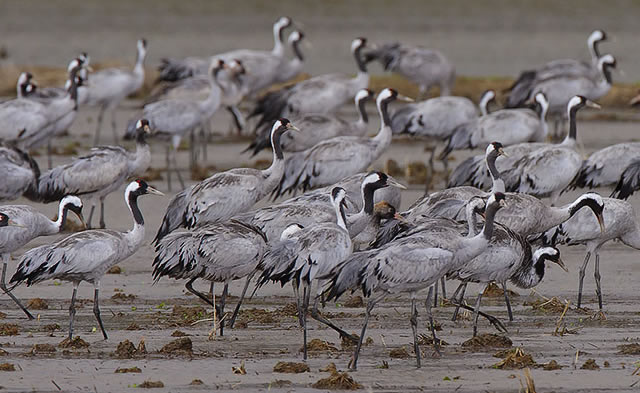
Cranes in Extremadura (Steve Fletcher)
The cranes feed on acorns in the ‘dehesa’ or wood pasture that is such a distinctive feature of Extremadura. They also feed in rice paddies and maize stubble fields, sometimes in groups, sometimes big flocks. And you can hear their evocative bugling: birds overhead or tucked out of sight in the holm oaks.
The cranes may be reason enough to travel to Extremadura in February, but there is much more. Other wintering birds include waterfowl and, on the steppes, flocks of golden plovers and lapwings, the latter avefría – cold bird – in Spanish.
Also on the steppes are impressive great bustards,
often in small parties as the breeding season
approaches. In the air, the sight of one of the world’s
heaviest flying birds is quite something. Other steppe
birds include little bustards, stone-curlews and both
pin-tailed and black-bellied sandgrouse.
Crested and calandra larks are also found in the plains. Another speciality is Spanish sparrow, a rather local bird in Spain despite its name.
|
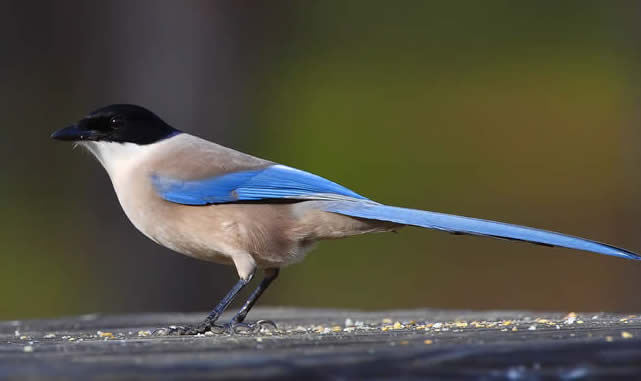
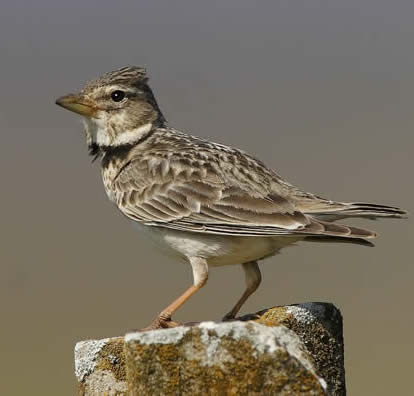 Calandra lark, above, and azure-winged magpie, left (Steve Fletcher). |
We will visit Monfragüe National Park, some 25 miles north of Trujillo. This is one of the most outstanding areas for seeing birds of prey in a country which is itself probably the best for raptors in Europe. It has the core Spanish population of black vultures, which breed here along with griffon vultures and both Spanish imperial and golden eagles. From the various crags, which make fine vantage points for raptor-watching, other species that can be seen include black stork, chough and rock bunting.
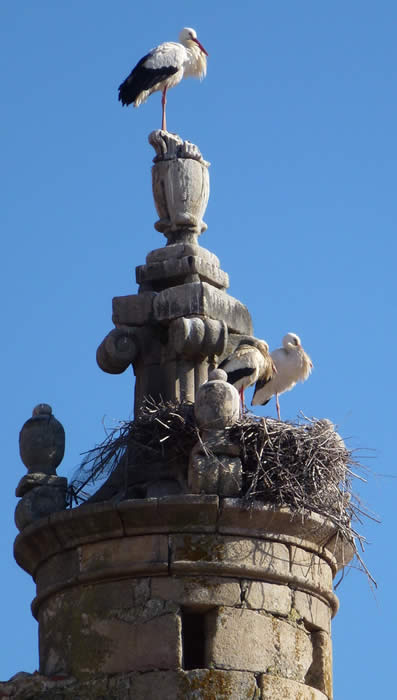
There are clear signs of spring, too, in February. White storks are bill-clapping on their huge nests. Lesser kestrels will be back along with other migrants such as great spotted cuckoo, martins and swallows.
We will stay - for the third time - at leader Martin Kelsey's Casa Rural called Casa El Recuerdo at San Clemente. San Clemente is in the countryside south of Trujillo.
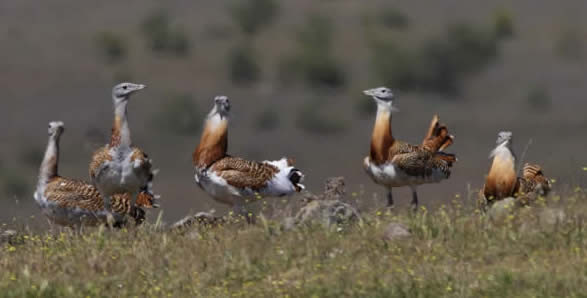
Great bustards (Steve Fletcher).
Birds
As well as those already mentioned, we should see a selection of the following: Bonelli’s eagle, red and black-shouldered kites, peregrine, raven, hoopoe, blue rock thrush, little owl, southern grey shrike, woodlark, Dartford and Sardinian warblers, hawfinch, cirl and corn buntings, Thekla lark, spotless starling and rock sparrow.
Flowers
Ahead of Extremadura’s fierce summer, the countryside is green, with wayside flowers such as Iberian milk-vetch and field marigolds. We will look for miniature daffodils: hoop petticoat and angel’s tears narcissi.
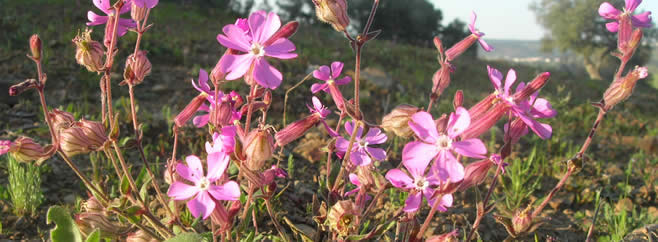
Mediterranean catchfly Silene colorata
Holiday details
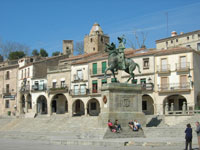
We will visit the Crane Information Centre, dehesa and rice paddies at Moheda Alta. Other excursions will include visits to Monfragüe Natural Park, including places such as Peña Falcón and the Tiétar cliffs; and exploration of the plains around Trujillo. We also spend a morning in the wonderful old town of Trujillo with its striking central square and breeding white storks and lesser kestrels.
Price: £1,700 per person in twin room for a full week (Monday to Monday)
Single room supplement: £200
En suite facilities
Flights: Scheduled Ryanair flights London Stansted – Madrid
5 February: FR5994 depart London Stansted 12:25 arrive Madrid 16:00.
12 February: FR5993 depart Madrid 16:40 arrive Stansted 18:10.
Another option is Edinburgh-Madrid with easyJet.
5 Feb EZY3209 Depart Edinburgh 12:20 arrive Madrid 16:20
12 Feb EZY3210 Depart Madrid 17:00 arrive Edinburgh 19:00
Deposit: £400
Maximum number (one leader): 7
We have six rooms reserved. With the usual mix of twins and singles, one minibus, talking seven plus driver comfortably, is the likely group, with Martin Kelsey as guide and driver. If by some chance we have 5 rooms with two people in each, there may be a co-leader/driver.
Conservation project
SUPPORTING
|
Traditional low intensity farming, especially non-irrigated arable farmland but also seasonal grazing, supports much of the special wildlife of Extremadura – and can never be protected just by nature reserves. The conservation of the Spanish steppes and ‘dehesa’ wood pasture is a great priority for the Sociedad Española de Ornitología (Spanish Ornithological Society / BirdLife Spain). |

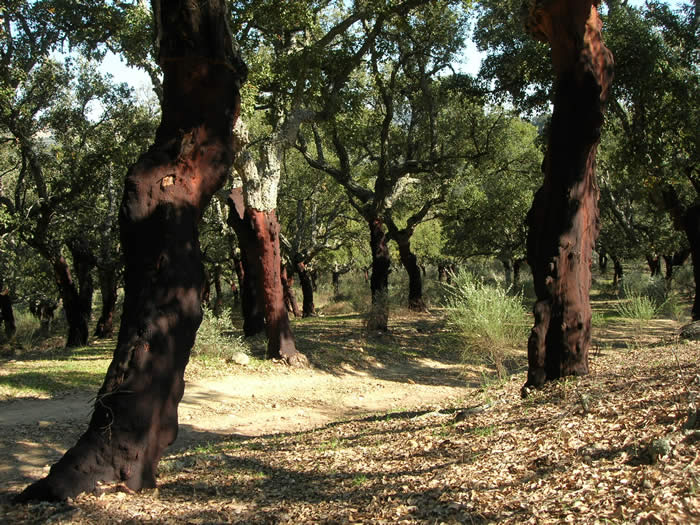
Cork oak dehesa in Extremadura
Leaders
Martin Kelsey OBE is our regular leader in Extremadura where he lives with his family, close to our former base at what used to be called Finca Santa Marta.
Martin and his wife Claudia have for many years run their own Casa Rural called Casa El Recuerdo at San Clemente.
Martin's background in ecology includes a three-year study on marsh warblers. After three years in the Amazon rain forest with the British Ornithologists' Union, where he met his Claudia, he worked for BirdLife International, before joining Save the Children.
Martin has been active in nature conservation and as a guide in Extremadura for many years. He is a committee member of GUIDEX, an association of professional bird & nature guides in Extremadura. Martin's blog about 'birds, natural history and life in general' in Extremadura is well worth following. This post is from mid-February 2014, and gives a good feel for Extremadura in February.
For prices, see Holiday Details at the bottom of the page.
 |
FCO travel advice for Spain here. |
Face masks
Spain has introduced the mandatory use of face masks in healthcare settings such as doctors' surgeries, hospitals or pharmacies, "Due to an increase in respiratory infections such as flu and COVID-19" (January 2024). No end-time for this is set.
Holiday reports
Most of our visits have been in March, and one in Sept/Oct. These Extremadura holiday reports on our holiday reports pages - about 25 reports in total since 1998.
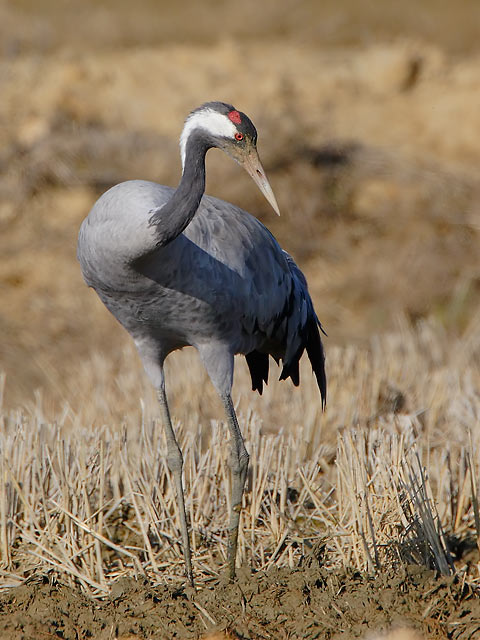
Crane (Steve Fletcher)
Extremadura photos
Gallery of photos mostly places and flowers.
Birds gallery photos by Steve Fletcher.
Birds of prey gallery photos by Steve Fletcher.
White storks in Trujillo
Useful information and links
Birding in Extremadura: website of the Government of Extremadura.
Birds of Extremadura illustrated map here. We send a printed copy to anyone who books or enquires about this holiday.
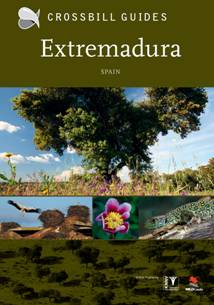
Recommended reading from Crossbill Guides: Extremadura.
|
 |
Honeyguide web pages about Extremadura
Extremadura flowers. This is is for flowers we see here — mostly on our March holidays — that aren't in the usual field guides.
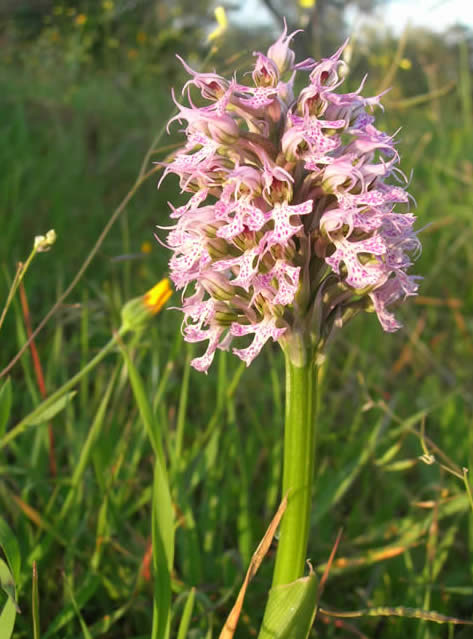
Orchis conica at Finca Santa Marta, in March. More orchids on our Iberian orchids page (also more for March holidays). |
 |
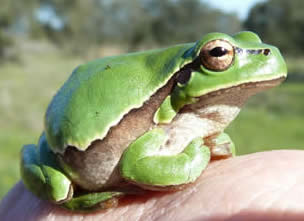 |
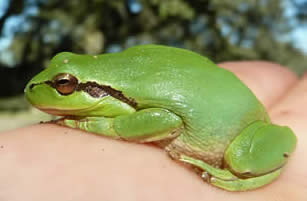
Tree frog
|
Stripe-less tree frog |
|

Marcelino Cardalliaguet from SEO accepts a cheque from Honeyguide (Malcolm Key).
Marcelino says Honeyguide is: "Currently the best example of sustainable tourism in Extremadura," and praises our "Direct support to local work for the conservation of Extremadura natural values."
Holiday leader
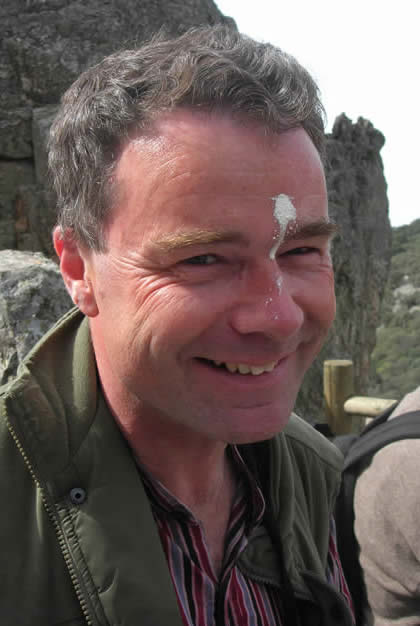
Martin Kelsey OBE, pictured (a little unfairly) after a vulture had just flown overhead. We don't go in for much photo manipulation, but the same photo has been in Honeyguide's brochure but with the dropping removed.
Martin is a committee member of GUIDEX, an association of professional bird & nature guides in Extremadura.
Martin is interviewed in El País about nature tourism in the region here. In Spanish, 20 September 2012.

