Destinations
2026
- South Africa: Cape & the Garden Route
- Extremadura
- Crete
- South of Salamanca
- Picos de Europa
- French Pyrenees (June)
- Bulgaria's Western Rhodopes
- Falsterbo
- Danube Delta
- Madeira
2027

... where there are many holiday photos to enjoy.

The air holidays shown are ATOL Protected by the Civil Aviation Authority. Our ATOL number is ATOL 3253. ATOL Protection extends primarily to customers who book and pay in the United Kingdom. Click on the ATOL logo if you want to know more.
Monarch butterflies
Monarch butterflies Danaus plexippus are rightly celebrated for their annual migration through North America to their spectacular winter roosts in pine trees in the mountains of Mexico. Many of us marvelled at the spectacle shown on David Attenborough's 'Life' programme on the BBC.
Yet as a European species they are much less known. However, Honeyguiders have enjoyed Monarchs in Madeira, Algarve and Tarifa, where they are resident rather than migratory, and it's these we feature here.
_____________________________
We start in the Tarifa area in southern Spain, with a new addition to this page about Monarchs and their Honeyguide links.
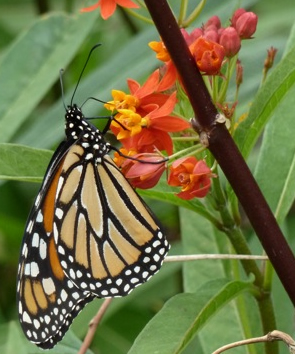 |
The group, in September 2011, saw Monarchs both at our base at Huerta Grande and nearby in the Los Alcornocales National Park. Here they were nectaring on bloodflower Asclepias curassavica, which is in the milkweed family, from America.
Monarch on Asclepias curassavica (Angela Shoulder) |
_____________________________
Being a long-distance migrant, it's not surprising that Monarchs often cross the Atlantic. They are an occasional migrant in western Britain and it's now well-known that they are established on the Atlantic islands of the Canaries, Azores and Maderia. Much less known – or at least published – is that they are also in Portugal's Algarve, where four Honeyguide groups have seen them, and the Tarifa area in southern Spain.
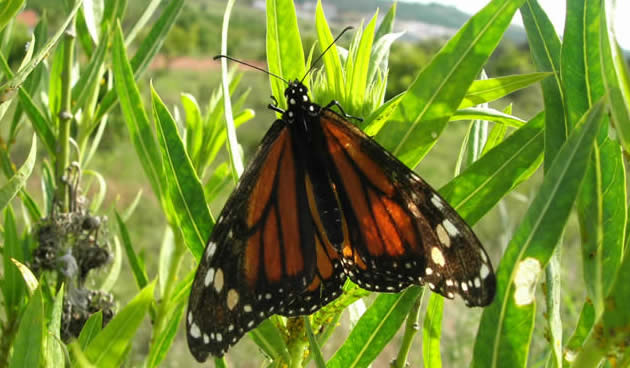
Monarch on silkweed plants, Algarve, April 2009
Being a long-distance migrant, it's not surprising that Monarchs often cross the Atlantic. They are an occasional migrant in western Britain and it's now well-known that they are established on the Atlantic islands of the Canaries, Azores and Maderia. Much less known – or at least published – is that they are also in Portugal's Algarve, where four Honeyguide groups have seen them, and the Tarifa area in southern Spain.
The food plant in Algarve is a member of the milkweed family, though a South African species rather than the many milkweeds Asclepias from North America.
Indeed another name for the Monarch is the milkweed, after this group of plants that the caterpillars favour. They absorb toxins in the milkweed, making them and the adult butterflies distasteful to birds and other predators.
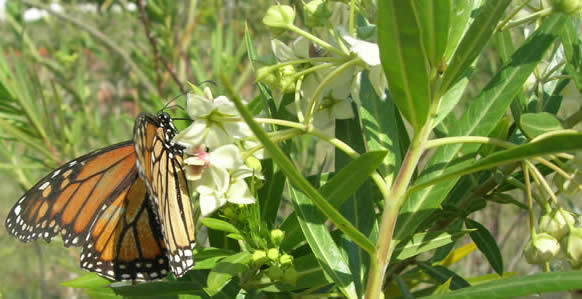
Silkweed with Monarch, Algarve, April 2007
The Algarve colony we used to visit – there are others – is near Silves. The silkweed grows on some open ground in a little triangle of roads, so making plants and caterpillars, with good timing and some searching, easy to photograph.
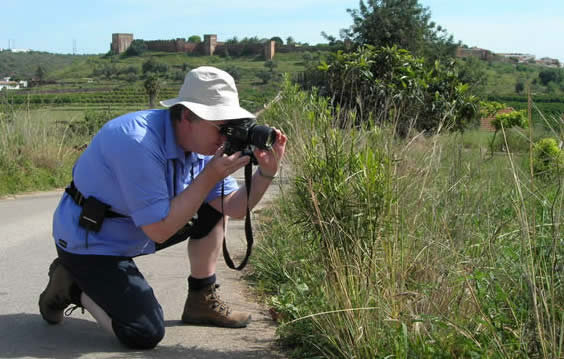
Honeyguider Sonia Donaghy zooms in on a Monarch caterpillar. Silves castle is in the background.
Photographing the fast-flying adults is much more of a challenge. A cool moment, freshly emerged butterflies or tatty old ones may be possible.
_____________________________
African Monarch
In South Africa's Garden Route (November 2009), I spotted a patch of milkweed opposite our base at Coral Tree Cottages. There were no caterpillars or other signs here, but the search was on for the similar African Monarch Danaus chrysippus aegyptius (also known as Plain Tiger, especially when seen in southern Europe - see bottom of RH column).
We were lucky: a regular breakfast venue down the road at Old Nick's had a wonderful extended garden. I was able to creep close to this butterfly on the lawn.
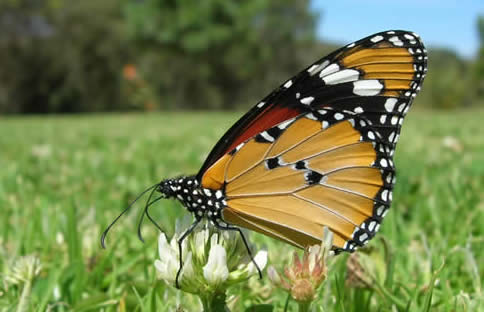
African Monarch
Monarch mimics: Because predators know Monarchs are poisonous, there are mimics. In Africa, female Mocker Swallowtails adopt several forms, including that of the distasteful Monarch. Read an article here about this in the Kruger National Park.
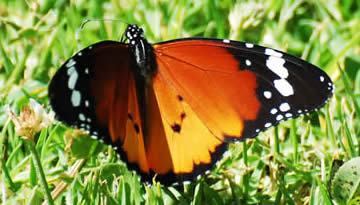 |
The upperside of the African Monarch lacks the distinctive black lines on the American species. (Photo by Rob May) |
Diadem: a mimic on Madeira
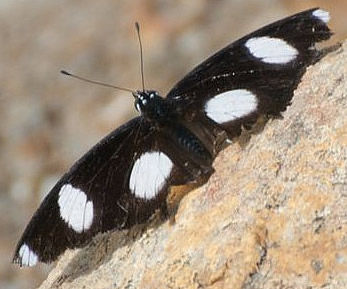
A post script to the above comes from our Madeira holiday in November 2012, where Honeyguide group members saw three males of the Diadem Hypolimnas misippus (Wikipedia entry here). The Diadem, also known as False Plain Tiger, is found in Africa and America.
 |
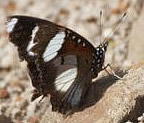 |
Male Diadem, upper and lower (Madeira Wind Birds). The females are the mimics, taking on the appearance of the toxic monarch butterfly, also seen on Madeira. |
Back to nature notes
Chris Durdin, November 2009, last updated November 2016
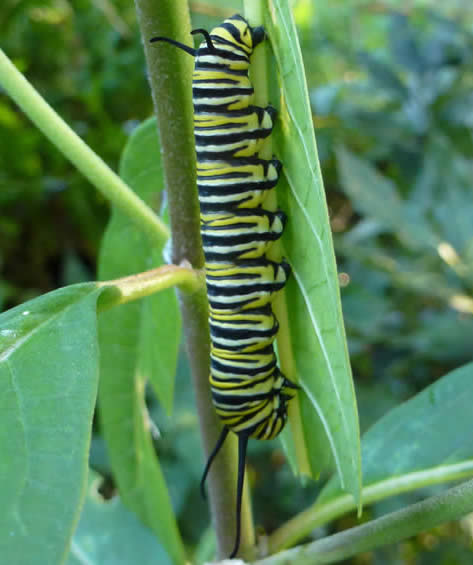
Monarch caterpillars were also on the Asclepias; indeed it looked like this potentially invasive alien was being kept in check by Monarchs.
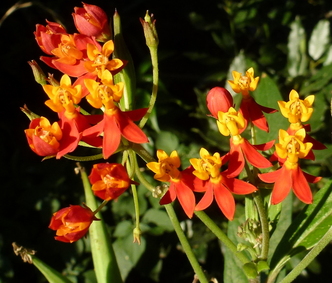
Bloodflower Asclepias curassavica. In the Tarifa area we also found bristle-fruited silkweed Gomphocarpus fruticosus, about which there is more below.
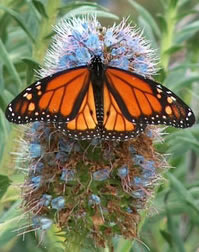
Below: Monarch on pride-of Madeira (Madeira Wind Birds). This one is a male: note the two dark spots (scent patches) and thinner veins.
More information
Monarchs on Wikipedia here and on Plain Tiger or African Monarch on Wikipedia here.
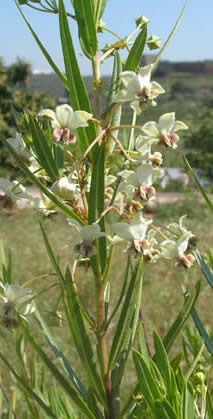
Bristle-fruited silkweed flowers; Silves Castle is in the background.
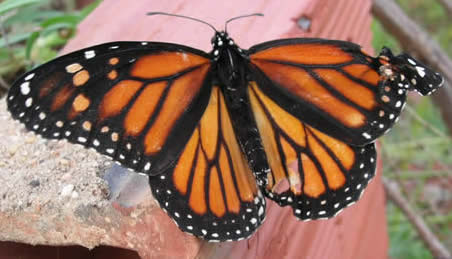
This crumpled looking Monarch in Algarve has probably just emerged from its chrysalis.
This one is a female: note the absence of the dark spots and thicker black veins.
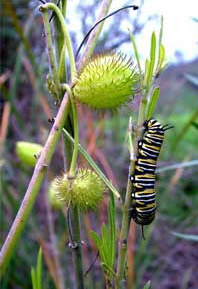 Monarch caterpillar with fruits of bristle-fruited silkweed (Brian Anderson)
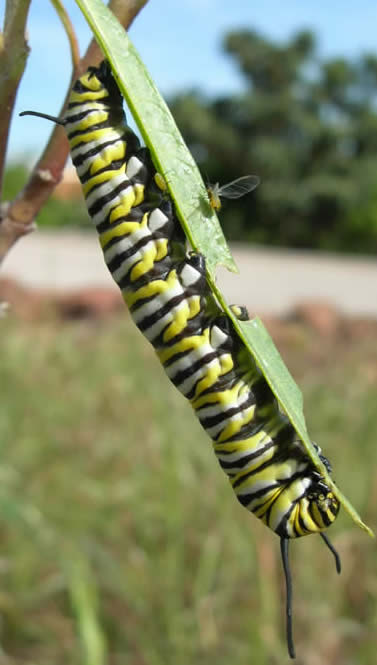
Monarch caterpillar, Silves, Algarve, April 2009
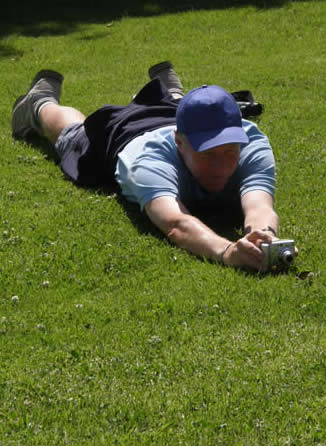
Chris photographing African Monarch (John Durdin)
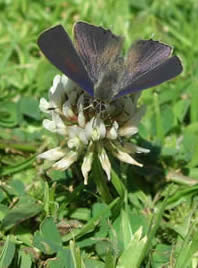
Rayed blue — same lawn!
Postscript: 2015-16
Andrew Ramsay looked for Monarchs without success at Silves, Algarve in May 2015, but found and photographed them at nearby freguesia de Pêra (on the N269 between Algoz and Silves).
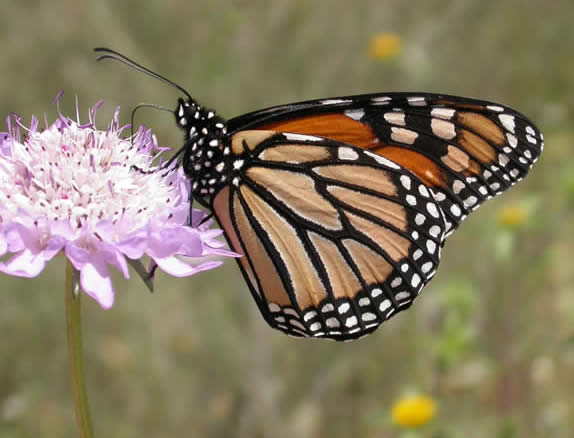
Monarch on scabious (Andrew Ramsay, 1 May 2015).
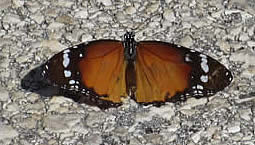
Plain Tiger, Kefalonia, Greece (David North, 20 Oct 2016).
