Destinations
2026
- South Africa: Cape & the Garden Route
- Extremadura
- Crete
- South of Salamanca
- Picos de Europa
- French Pyrenees (June)
- Bulgaria's Western Rhodopes
- Falsterbo
- Danube Delta
- Madeira
2027

Air Travel Organiser's Licence
You may have noticed in the bottom left hand side of all of our web pages there is an ATOL logo – like the one to the right. ATOL 3253 is Honeyguide's unique ATOL number and this shows that all monies paid by you for our air holiday packages are ATOL-protected. The ATOL system is run by the Civil Aviation Authority. Honeyguide is one of around 1,630 ATOL holders (April 2024).
This web page is to explain a little more about this and related matters.
Holidays not covered by Honeyguide's ATOL
Though our holidays are all offered with flights, occasionally Honeyguiders may prefer to:
(1) travel to one of our destinations by means other than flying, or
(2) buy their own flights, nowadays easy to do on the internet and sometimes a practical response when travel arrangements are complex. This especially applies to Honeyguiders outside the UK.
At the moment, any travellers for whom Honeyguide does not buy a flight is not covered by Honeyguide's ATOL.
This is a pity as travelling by train, in particular, is a trend we would like to encourage, to reduce dependence on air travel with its contribution to climate change. We will do our best to help, for example by planning how to meet up with the group at the holiday destination. This blog - Honeyguide holidays without flights - pulls together several discussion strands and ideas on this potentially wide-ranging subject.
ATOL-protection only applies to UK residents.
Your ATOL protection for flight-inclusive holidays
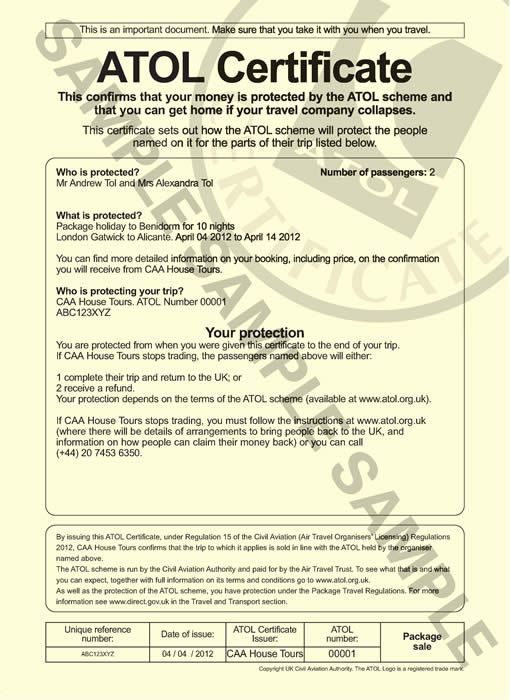
All the flights and flight-inclusive holidays on this website are financially protected by the ATOL scheme. When you pay you will be supplied with an ATOL Certificate. Please ask for it and check to ensure that everything you booked (flights, hotels and other services) is listed on it.
Our booking conditions have further information. These include standard wording from the CAA, which you can also read here: our ATOL Terms and Conditions. These were part of the booking details when we had a brochure, and now on the PDF booking form/conditions on our booking page.
For more information about financial protection and the ATOL Certificate go to: www.atol.org.uk/ATOLCertificate.
Protecting the consumer
Every tour operator offering 'packages' – that is holidays that include more than one element, such as flights, accommodation and local transport – has to provide the buyer with protection. The framework for this is the EU's Package Travel Directive and UK regulations that flow from that.
When it's a flight-inclusive package – as all Honeyguide holidays presently are – then tour operators must hold an Air Travel Organiser's Licence. It ensures that in the event of a tour operator becoming insolvent, consumers already abroad can complete their holidays and be returned to the UK and those who have paid for their holidays but have not yet departed will receive a full refund.
Honeyguide has held an ATOL since 1993. It's what the CAA calls a 'Small Business ATOL' (SBA), for tour operators running fewer than 500 holidays a year. The ATOL Certificate, issued to our travellers since October 2012, looks like this (right). Honeyguide presently prints these in black and white. More information on the ATOL pack peace of mind campaign on the right. |
 |
A little bit of history
The ATOL scheme started in 1973, so a quick bit of arithmetic shows it's been going for more than 50 years. "Millions of consumers supported as ATOL hits 50" was written by the CAA to mark the 50 year anniversary in 2023, including information on some of the bigger events dealt with, such as the collapse of the XL Leisure group in 2008, and: "In 2017 and 2019 respectively, Monarch and Thomas Cook collapsed, with the ATOL team overseeing the repatriation of hundreds of thousands of holidaymakers who were abroad." Honeyguide has had an ATOL for more than 30 years, so more than half of the time that the scheme has been in place.
ATOL Protection Contributions
ATOL Protection Contributions (APCs) were introduced in April 2008 to raise funds for the Air Travel Trust Fund (ATTF), which meets the insolvency protection costs of the ATOL scheme. The failure of XL Leisure group in September 2008 and the effects of the recession at the time caused serious financial challenges for the ATTF.
Following a consultation by the CAA in early 2009, the APC paid by travel companies to the ATTF rose from £1 to £2.50 per passenger. This sum is included within the price of any ATOL-protected Honeyguide holiday.
Comment: on the one hand, it is irritating that travellers with generally sound small operators are caught by a problem created by the collapse of one large business. On the other hand, it remains a relatively small sum per person to support the robust and valuable ATOL scheme. When it came in, the travel press quoted various leading lights from big operators in the travel industry suggesting this increased charge will bring travel its knees. These claims can be taken with a pinch of salt.
Accountancy and ATOL protection — an essential support
Several years ago, the Civil Aviation Authority introduced a requirement that the reports supplied by an ATOL holder like Honeyguide must be verified by an ATOL Reporting Accountant (ARA).
In the words of the CAA (from here): "The ATOL Reporting Accountants' scheme has been developed by the CAA in order to help improve the standard of ATOL reporting and to provide assurance that financial information which is submitted on behalf of ATOL holders is accurate. The scheme is designed to ensure that designated accountants of participating bodies are sufficiently knowledgeable about both the industry and specific requirements of ATOL to provide the required assurance needed by the CAA."
Any accountant who wishes to be an ARA has be approved by the CAA; the process includes online training and continuing professional development. Honeyguide's then accountants did not want to jump through those hoops, but happily we were able to move to Stephenson Smart, partly based in Fakenham, Norfolk. Stephenson Smart has developed ATOL work as a specialism: more here.
One of Stephenson Smart's partners, Martyn Benstead, as well as qualifying as an ATOL reporting accountant, is also the Honorary Independent Examiner providing accountancy services to the Norfolk & Norwich Naturalists' Society — chiming with Honeyguide's values. Mike Rowles, who is also an ARA, provides our day-to-day support.
Honeyguide would like to thank Stephenson Smart's support for the essential if tedious figure work related to ATOL renewal, and for its general support, including during the difficult time of the coronavirus pandemic.
Future developments for ATOLs
In December 2009, the Department for Transport published proposals
"... for modernising the Civil Aviation Authority’s regulatory framework." (Full details here.) Much of this is to clarify and improve the scope of the ATOL system, especially in the light of some failures of big travel companies and to respond to how people buy holiday components on the internet.
They propose that non-air holidays can be covered by an ATOL in future - see right for the full text.
Honeyguide welcomes this proposed change. In our response to the Department for Transport we said we:
"... support the proposal to extend the scope of ATOLs to non-air packages. This is for the reasons set out in paragraph 13.75, namely to offer protection to consumers but to keep costs low and bureaucracy simple by being able to include a small number of non-air package holidays within the ATOL."
Update, July 2011: the Government’s public consultation on the reform of the Air Travel Organisers’ Licensing (ATOL) Scheme (June 2011)
"The proposal to extend the scope of ATOL to non-flight packages has not been included in the current consultation. This proposal received some support during the 2009 Regulating Air Transport consultation, and we have certainly not ruled out including this measure in the medium to longer term reforms of the ATOL scheme."
This page first published January 2010, last updated April 2025.

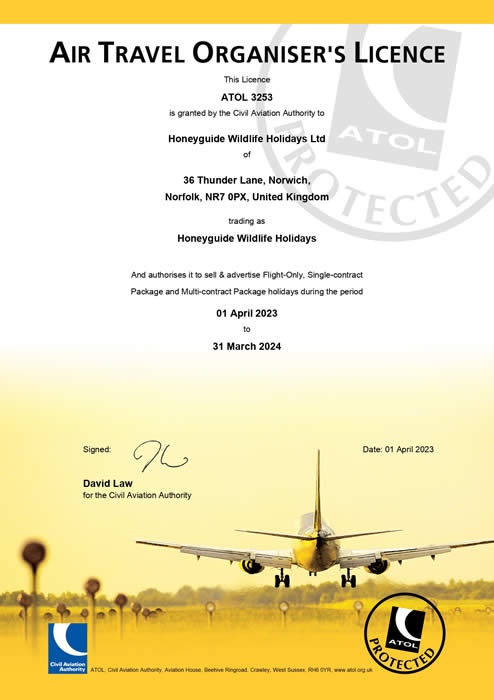
Honeyguide's Air Travel Organiser's Licence 2026-27 here (Honeyguide's 33rd renewal).
Honeyguide's Air Travel Organiser's Licence 2025-26 here (Honeyguide's 32nd renewal).
Honeyguide's Air Travel Organiser's Licence 2024-25 here (Honeyguide's 31st renewal).
Honeyguide's Air Travel Organiser's Licence 2023-24 here (Honeyguide's 30th renewal).
You can also see Honeyguide's ATOL on the CAA's check-an-ATOL web page.
Accountancy
Part of the ATOL process is have an accountant that is qualified as an ATOL Reporting Accountant (ARA).
Honeyguide's accountants are Stephenson Smart, in our case their office in Fakenham, Norfolk, who have taken the training to be an ARA.
Honeyguide features as a case study on Stephenson's Smart website, the timing of which relates especially to the lockdown period.
News
Blog: Honeyguide holidays without flights November 2024
'Rebalancing ATOL': this was the name of proposals by the CAA to make changes to the ATOL system, to reduce the impact of companies going bust. Initially doing away with the Small Business ATOL (SBA) was proposed, but in response to a raft of comments about the problems this would bring for SBA holders (Honeyguide's comments here), the CAA decided (March 2015) to keep the SBA. Tougher criteria for new SBAs will be introduced, and a qualification for accountants verifying ATOL returns.
All ATOL holders have an 'Accountable Person' and he or she must complete an online training course on the role by February 2015. Honeyguide's accountable person is Chris Durdin, who completed the course in December 2014. View the CAA certificate here.
Updated ATOL wording and terms & conditions, see 'Your ATOL protection', left.
Pack peace of mind
The CAA's website promoting ATOLs www.packpeaceofmind.co.uk launched December 2012.
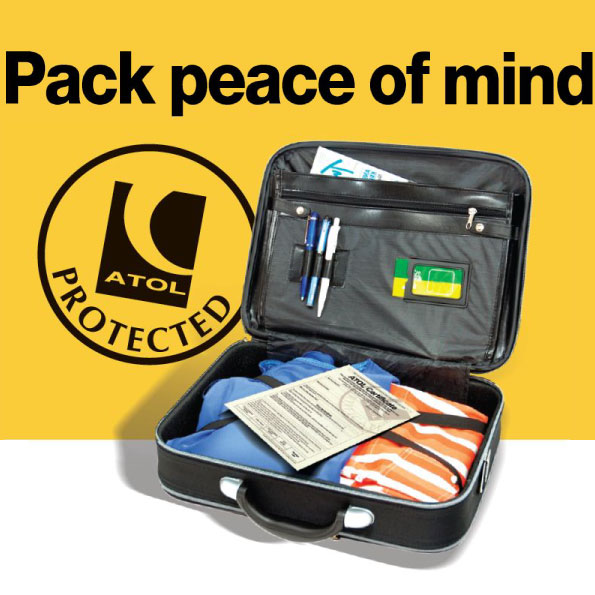
Download the 'Pack Peace of Mind leaflet here. |
 |
The latest phase of the campaign (January 2015) has new graphics of 'Justine Case and family' (below) and is due to be repeated in early 2016.
It "... is targeting families who may be more price driven and more likely to book with unprotected travel companies. We are therefore encouraging families to look beyond the price and make sure their holiday is ATOL protected."

Your financial protection
When you buy an ATOL protected air holiday package from Honeyguide Wildlife Holidays you will receive an ATOL Certificate
from us confirming your arrangements and your protection under our Air
Travel Organiser’s Licence number 3253.
In the unlikely event of our insolvency, the CAA will ensure that you are not stranded abroad and will arrange to refund any money you have paid to us for an advance booking. For further information visit the ATOL website at www.atol.org.uk or www.packpeaceofmind.co.uk.

The price of our air holiday packages includes the amount of £2.50 per person as part of the ATOL Protection Contribution (APC) we pay to the CAA. This charge is included in our advertised prices.
ATOL Protection does not apply to holiday and travel services when a flight is not included. Please ask us to confirm what protection may apply to your booking.
| You can read the original ATOL 'Peace of Mind for Air Travellers' information here | |
Extract from the Department for Transport's proposals to widen the scope of the ATOL system.
"13.75 Many companies sell both air and non-air holidays and would prefer to protect them all through the CAA to reduce costs and bureaucracy. It is proposed as a Better Regulation measure that these companies are given the option of protecting all their packages, both air and non-air with the CAA by contributing financially to the Air Travel Trust, the body that manages the funds collected to meet the costs of ATOL protection. This arrangement would be available to companies whose main business is selling air based package holidays under the ATOL scheme, but who also sell a small amount of non-air package holidays. These companies are likely to face the greatest burden of having to protect their products under two sets of arrangements."
CAA staff kindly checked this web page when it was first in draft, and were happy with its contents.
The ATOL Licensing team also reviewed changes made in February 2014 and confirmed they were correct. Those changes were to use the CAA's current recommended wording about ATOL protection.
