Destinations
2026
- South Africa: Cape & the Garden Route
- Extremadura
- Crete
- South of Salamanca
- Picos de Europa
- French Pyrenees (June)
- Bulgaria's Western Rhodopes
- Falsterbo
- Danube Delta
- Madeira
2027

... where there are many holiday photos to enjoy.

The air holidays shown are ATOL Protected by the Civil Aviation Authority. Our ATOL number is ATOL 3253. ATOL Protection extends primarily to customers who book and pay in the United Kingdom. Click on the ATOL logo if you want to know more.
Iberian orchids
If you are visiting Spain and Portugal, you may find the notes on the following species helpful. This isn’t a complete guide by any means; it concentrates on orchids that are only or mostly on the Iberian peninsula and are quite likely to be found on some of our spring holidays.
Orchid names and taxonomy are prone to change, so the names you see on this page may not match your flower book or other reference. It would be fair to say that orchid buffs study them carefully and some are keen on ‘splitting’ – defining new species. Delforge (see right) splits many forms into species. More recent books by Chris Thorogood, published by Kew, 'lump' and name fewer species.
Conical orchid Orchis conica
This showy species is common near Finca Santa Marta, our Extremadura holiday base until 2019. I was calling it milky orchid Orchis lactea as recently as 2007. My excuse is that Mediterranean Wild Flowers by Grey-Wilson & Blamey doesn’t have this species and even the excellent Crossbill guide to Extremadura lists Orchis lactea rather than Orchis conica. Delforge says that Orchis conica probably replaces Orchis lactea in the Iberian peninsula. Another similar and closely related species is toothed orchid Orchis tridentata. It is quite conical, wouldn’t you say?
Find this orchid in Extremadura and, with luck, holidays in Central Portugal, La Mancha and
Valencia.
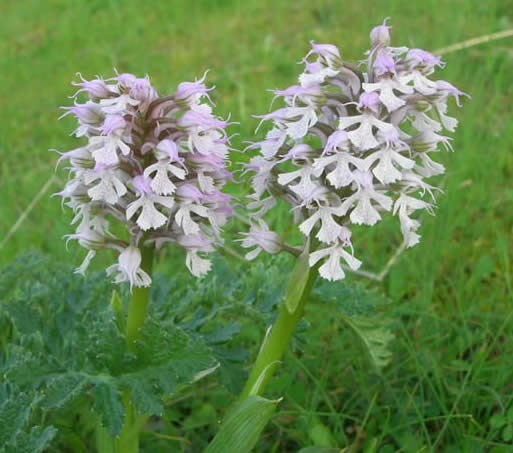
Two Orchis conica at Finca Santa Marta
Orchis olbiensis
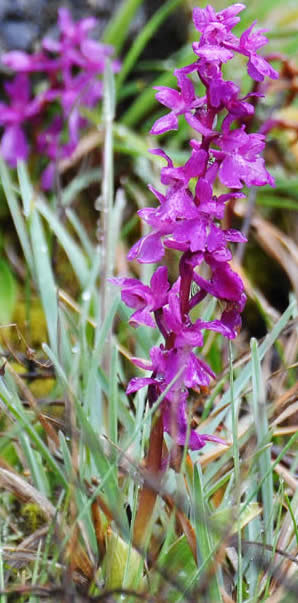
You may sometimes see names written such as Orchis (mascula) olbiensis. This may indicate that it’s an uncertain split from Orchis mascula – early purple orchid – but we sometimes also use this way of listing a species just to show what it’s closely related to – and therefore looks rather like. Orchis olbiensis (or sometimes Androrchis olbiensis – see photos in right hand column – tends to flower earlier than O. mascula, and have fewer & paler flowers. Immediate right, for comparison: early purple orchid Orchis mascula, Portugal, April 2012 (Rob May). |
 |
Find this orchid in Valencia, Central Portugal, La Mancha and Algarve (references here to Algarve are to a spring holiday, not the now more usual autumn holiday).
Lusitanian mirror orchid Ophrys vernixia
Blamey calls this Ophrys speculum subsp lusitanica and you can see it’s a little like a mirror orchid Ophrys speculum but much thinner and elongated, reminiscent of a fly orchid Ophrys insectifera.
Find this orchid in Algarve and Central Portugal.
Champagne orchid Orchis champagneuxii
Blamey calls this Orchis morio subsp champagneuxii; look carefully and you can see the green veins found in Orchis morio, the green-winged or green-veined orchid. It’s another showy species we see at Finca Santa Marta in Extremadura. The name is nothing to do with colour, fizz, or the Champagne region, even though it does occur in southern France: it’s named after a French botanist M. A B Champagneux. The lip is folded along the middle, so it can look narrower than green-winged orchid from the front, and the spur is thickened at the tip.
Find this orchid in Extremadura, Central Portugal and Valencia.
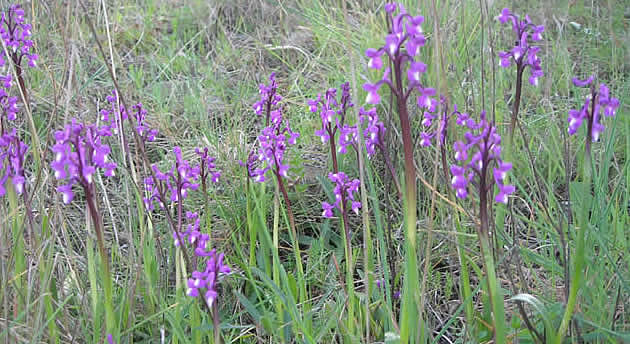
Champagne orchids at Finca Santa Marta
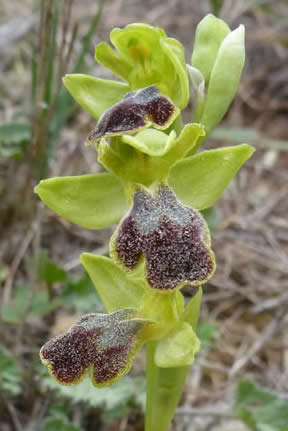 |
Ophrys dyrisThis is a Portugal variant on the group related to sombre bee orchid Ophrys fusca. (Photo, right.) Ophrys lucentinaAlso known as Ophrys dianica. Lucentina means from Alicante, Lucentum of the Romans. Some class this as a sub-species of Ophrys fusca, sombre bee orchid, though the yellow edge to the lip makes it look a little like Ophrys lutea, yellow bee orchid. Photographed in Valencia, February 2016. |
Epipactis lusitanica
This helleborine (photo, right) was a new one on me in Algarve in April 2009. Delforge puts this in a group with Epipactis tremolsii, which isn't in Blamey & Grey-Wilson's book either, but at least the name lusitanica shows that it's to be expected in Portugal. Its rather small leaves are a distinctive feature.
Chris Durdin, April 2009, with later additions and updates.
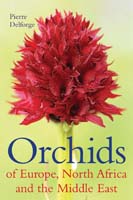
There are many books on orchids but this is the book: Orchids of Europe, North Africa and the Middle East by Pierre Delforge (A&C Black) (currently out of print, only over-priced 2nd hand copies online). There are also valuable regional orchid guides, including one in Extremadura.
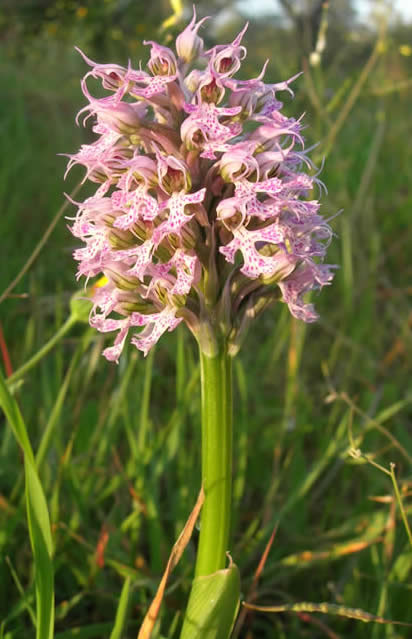
Orchis conica
If you like orchids, have a look at our Dordogne orchid gallery and our Crete orchid gallery.
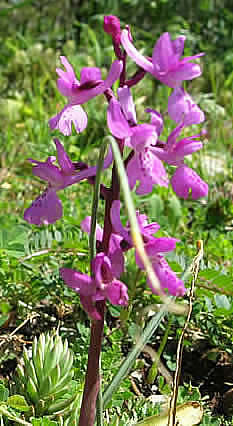
Orchis olbiensis
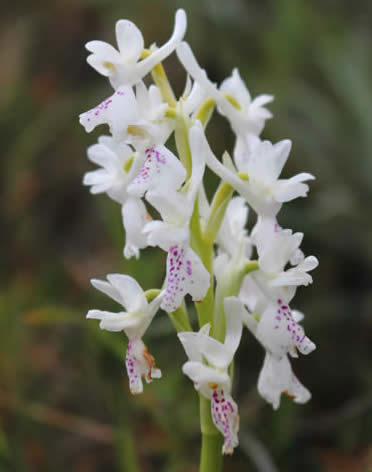
Orchis olbiensis (Pau Lucio)
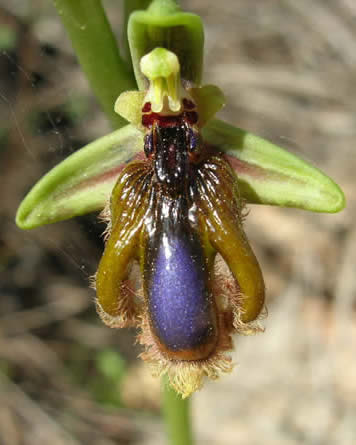
Lusitanian mirror orchid Ophrys vernixia
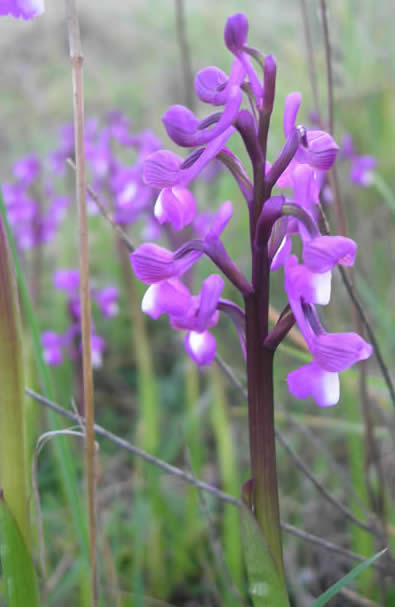
Champagne orchid
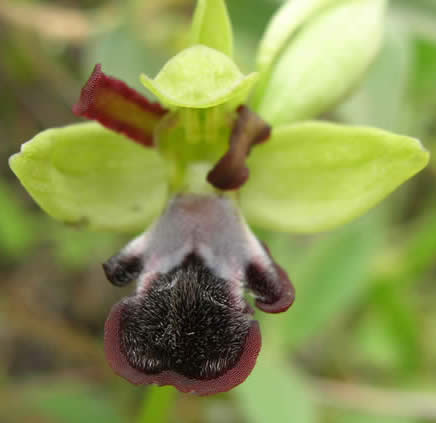
Ophrys dyris
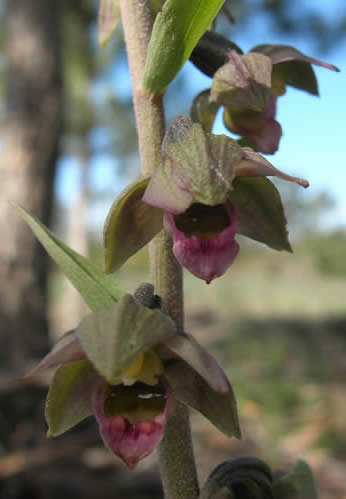
Epipactis lusitanica
Useful links
Honeyguide pages:
La Mancha flora: includes Orchis cazorlensis.
Extremadura flowers.
Valencia orchids: see list and photos on our 2018 report here.
PDF of a guide to orchids in Extremadura here.
External links:
Extremadura Project Orchid website in Spanish here.
Orchid photos by Pau Lucio
More on Spanish orchids, from John Muddeman, here.
Best website for flowers of Spain: Flora silvestre del Mediterráneo.
